Fermentation Tank Scheduling for Seasonal Anchovy and Mixed Fish Supply
Fish sauce factories do not schedule fermentation in a spreadsheet alone. They schedule around landing seasons, fish size, protein condition, salt availability, tank geometry, climate, labor windows, and the long patience required for mature aroma.
When anchovy landings arrive heavily in one period, tanks fill fast. When supply shifts toward mixed fish, the fermentation profile changes again. The practical question for a fermentation manager is not simply how to start more batches. It is how to protect consistency across the year while avoiding tank lockup, uneven nitrogen release, and aroma variation that shows up months later.
SaltPulse Bioworks works as an enzyme supplier for fish sauce fermentation where traditional craft needs plant-scale control. The aim is not to replace long fermentation character. The aim is to help factories plan more predictable protein breakdown, brine behavior, and maturation progression under high-salt operating conditions.
Why seasonal fish supply creates tank pressure
Anchovy and mixed fish do not enter the factory with the same composition every week. Seasonal differences can affect:
- Protein level and tissue firmness
- Fat content and oxidation risk
- Fish size distribution
- Freshness at unloading
- Salt uptake during early mixing
- Brine separation behavior
- Aroma trajectory during maturation
A factory may have enough tank capacity on paper, yet still face pressure if several high-volume receiving days arrive together. Once tanks are committed, they remain occupied through long maturation cycles. A poor start can consume capacity while producing a batch that needs corrective blending later.
Build the schedule backward from finished sauce demand
A stable tank plan starts with the commercial calendar, not the receiving dock. Work backward from expected drawdown, filtration, blending, packaging, and customer shipment windows.
For each product grade, define the production reality:
- Target maturation profile
- Expected extraction window
- Blend flexibility by grade
- Tank availability by month
- Fish supply probability by season
- Risk tolerance for mixed raw material streams
This backward view helps the plant avoid a common problem: filling tanks during the landing peak without reserving capacity for later balancing batches.
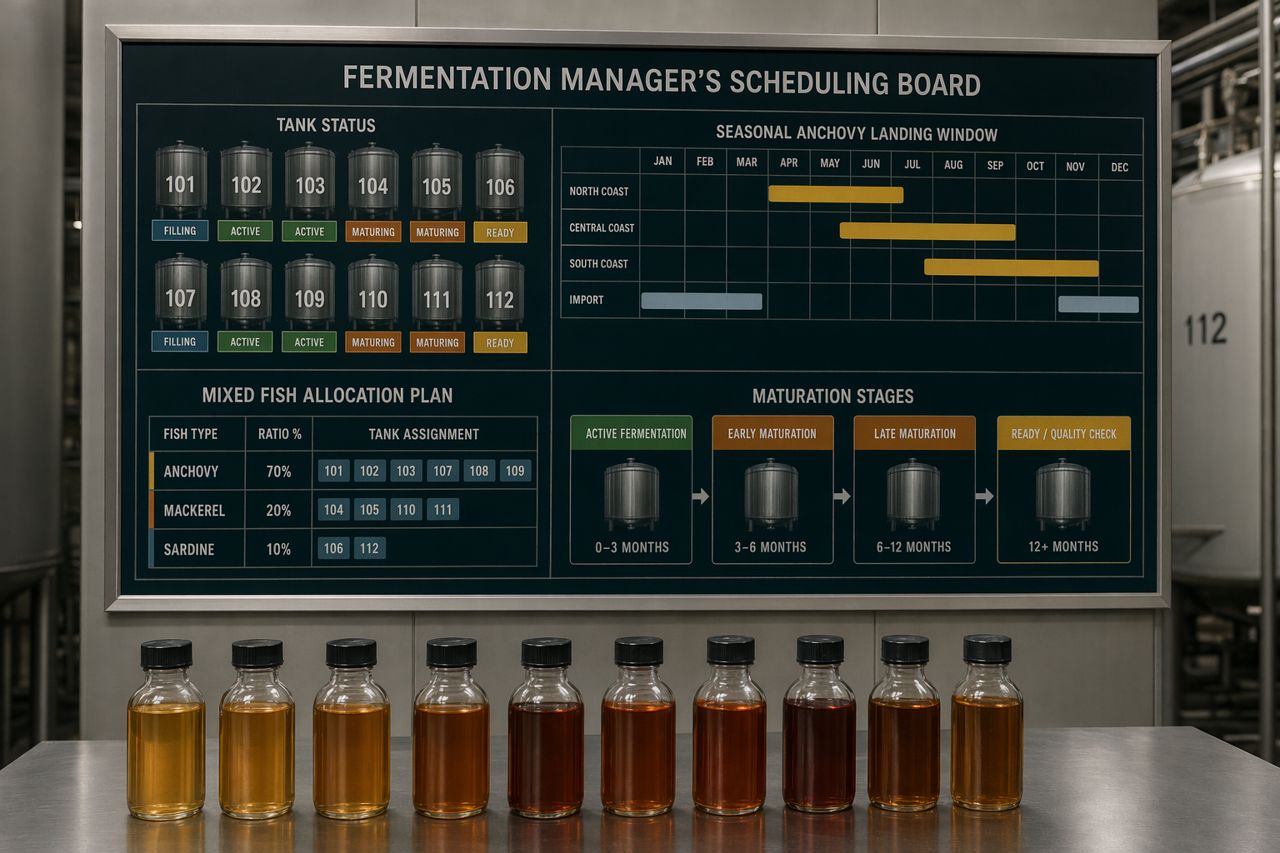
Segment tanks by raw material behavior
Not every tank should carry the same scheduling role. A practical fish sauce facility often benefits from separating tanks into operating categories.
Primary anchovy tanks
Use these for the cleanest seasonal anchovy supply when the goal is high aroma clarity and premium-grade blending strength. Protect these tanks from unstable raw material changes where possible.
Mixed fish stabilization tanks
Mixed fish can be valuable, but it benefits from deliberate scheduling. These tanks should be tracked closely for early brine formation, solids behavior, and aroma direction.
Flexible correction tanks
Keep selected tanks available for strategic batches that can support blending, nitrogen balance, or aroma rounding later in the year.
Trial and validation tanks
Before changing enzyme approach, salt strategy, or raw material mix at full scale, reserve controlled tank space for plant-relevant validation. This reduces risk before the method enters the main production schedule.
Where salt-tolerant enzyme support fits
In high-salt fermentation, enzyme selection must respect the environment of the tank. The useful question is not whether protein can be broken down in theory. It is whether the enzyme approach remains practical in salted fish mass, supports consistent nitrogen release, and does not disrupt the aroma pathway that defines the factory’s house profile.
For scheduling, enzyme support can help managers plan around:
- More predictable early protein breakdown
- Better alignment between raw material condition and maturation target
- Reduced variation between seasonal lots
- Faster visibility into whether a batch is tracking normally
- Improved confidence when mixed fish supply must be used
- More stable planning for extraction, blending, and tank turnover
This is where a specialized enzyme supplier for fish sauce fermentation should be evaluated: not as a catalog source, but as a process partner for salted substrate, long maturation, and factory-scale reliability.
A practical seasonal scheduling model
1. Classify incoming fish before tank assignment
At receiving, classify lots by species mix, freshness, size, oiliness, and expected protein contribution. Do not assign tanks only by arrival order. The earliest tank decision often determines the batch’s blending value months later.
2. Match fish class to tank role
Premium anchovy supply should not be diluted by convenience scheduling. Mixed fish lots should be directed toward tanks designed for controlled variability. If a lot is borderline, decide whether it belongs in a correction strategy rather than a flagship batch.
3. Reserve capacity during landing peaks
Peak supply creates pressure to fill every vessel. Resist full commitment unless the annual plan requires it. Holding back strategic capacity can protect the factory when a better landing arrives, a batch needs balancing, or customer demand shifts.
4. Use enzyme strategy by batch objective
A premium aroma batch, a mixed fish utilization batch, and a correction batch may not need the same enzyme approach. The schedule should connect enzyme use to the intended production role of each tank.
5. Review early indicators before the tank is forgotten
Fish sauce fermentation is long, but early tank behavior still matters. Track brine formation, solids settling, aroma direction, and nitrogen progression. Early data can guide whether a batch should stay on its original schedule or be reassigned in the blend plan.
Planning around variable protein levels
Seasonal fish supply changes nitrogen potential. A tank filled with lower-protein or more variable raw material may occupy the same physical space while delivering less blending strength later. That is a hidden capacity cost.
A better schedule accounts for expected nitrogen release by raw material class. If a mixed fish season is likely, plan additional control points and reserve blending support. If a strong anchovy season is expected, protect tank space and salt logistics so the plant can capture that value cleanly.
Tank scheduling checklist for fermentation managers
Use this checklist before the landing season begins:
- Which tanks are reserved for premium anchovy batches?
- Which tanks can absorb mixed fish variability?
- Which tanks must remain flexible for mid-season correction?
- How will incoming lots be classified before tank assignment?
- What is the target maturation role of each batch?
- Where will enzyme support be used to improve predictability?
- How will early batch behavior be reviewed and documented?
- What finished sauce demand must the schedule satisfy later in the year?
- Which batches are likely to become blend anchors?
- Which batches are likely to become background volume?
Protect tradition by controlling variation
Traditional fish sauce craft depends on time, salt, fish quality, and careful judgment. Modern scheduling should not flatten that character. It should protect it.
By pairing raw material classification, tank role planning, and salt-tolerant enzyme support, factories can reduce avoidable variation while preserving the mature amber profile customers expect.
SaltPulse Bioworks supports fermentation teams that need practical, plant-scale enzyme guidance for seasonal fish supply, mixed fish utilization, and reliable maturation planning.
Request a quote
If your factory is reviewing tank scheduling for the next anchovy season or planning better use of mixed fish supply, request a quote through the on-site form. Share your raw material pattern, salt conditions, tank schedule, and target product grades. Our team will help identify the enzyme supply approach that fits your fermentation plan.